
WELCOME BONUS 300%
UP TO €2000 + 100
FREE SPINS
UP TO €2000 + 100
FREE SPINS
Home → Blackjack
Blackjack at Freshbet Casino: Variants, Rules and Payouts
How long do 100 EUR last at a 1 EUR table?
With a 1 EUR bet at a table featuring Blackjack Liberal Vegas Strip, a player's 100 EUR could potentially last for 100 rounds if no losses occur. This specific variant boasts a favourable RTP of 99.72%, with a house edge of just 0.28%. Such a low house edge means that, over extended play, the casino expects to retain only 0.28 EUR for every 100 EUR wagered.
However, this calculation assumes perfect play and does not account for the inherent variance in blackjack. For instance, the Blackjack 6:5 variant, with an RTP of 98.15%, would see 100 EUR deplete significantly faster due to the increased house edge of 1.85%. This means a deviation from optimal strategy or a string of unlucky hands can shorten playing time.
The duration of 100 EUR at a 1 EUR table is thus highly dependent on the chosen game variant and player skill. While tables like Blackjack Liberal Vegas Strip offer a theoretically longer playtime due to their 0.28% house edge, actual session length is subject to chance. A player aiming for extended play would benefit from understanding the RTP of each blackjack variant before placing their wagers.
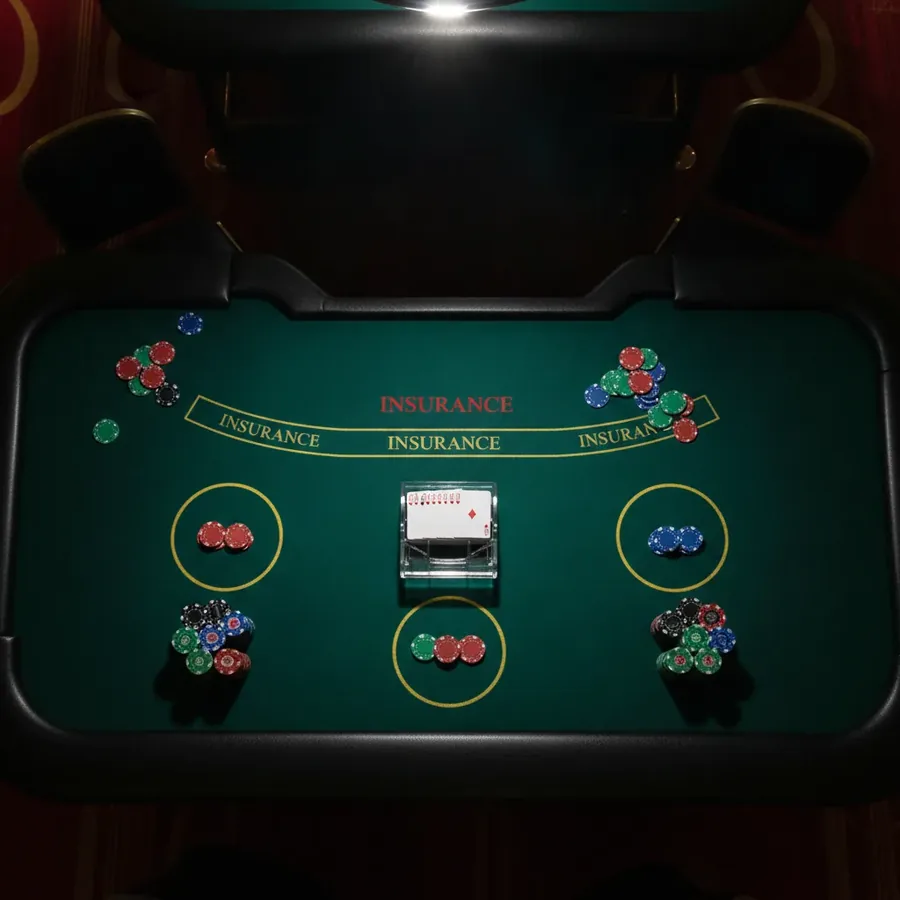
Error insurance: 7 percent additional house edge
Blackjack Insurance, when offered with 6–8 decks, presents a significant disadvantage to the player with a house edge of 7.47%. This side bet, which can be up to 50% of the main wager, is only advisable under specific card-counting conditions. The base strategy consistently advises against taking insurance, as it is a separate wager with a poor RTP.
The RTP for Blackjack Insurance in a standard 6–8 deck shoe is merely 92.53%, a stark contrast to the main game's potential RTPs. For example, Blackjack 6 Decks, S17, DAS, DOA with optimal strategy provides an RTP of 99.54%. This difference highlights how a seemingly small side bet can drastically increase the casino's overall profit margin during a session.
Only in very specific scenarios, such as when a true count reaches +3 or higher for experienced card counters, does the insurance bet approach a break-even point. For the vast majority of players, however, accepting Blackjack Insurance at 7.47% house edge is an error that significantly reduces their expected return and is best avoided.
Continuous Shuffling Machine shuffles after each round
The implementation of a Continuous Shuffling Machine (CSM) in some blackjack variants means the cards are shuffled after every hand. This contrasts with traditional shoe games where multiple rounds are played before reshuffling. While CSMs are common in live dealer environments, their impact on game dynamics is significant.
Games utilizing a CSM, such as Infinite Blackjack by Evolution, often have side bets like Any Pair, 21+3, Hot 3, and Bust It. These side bets are independent of the main game and are evaluated on the initial two cards dealt to the player and the dealer's upcard. The RTP for Infinite Blackjack is listed at 99.47%.
The constant shuffling inherent in CSMs effectively prevents card counting strategies from being viable. Players cannot track cards played to gain an advantage, as the deck composition is reset with each round. This ensures a consistent house edge, as seen in the 99.47% RTP for Infinite Blackjack, regardless of player attempts to gain an edge through counting.
Soft 17: Dealer Hits or Stands
The rule regarding whether the dealer hits or stands on a soft 17 significantly impacts the house edge in blackjack. In variants where the dealer hits soft 17 (H17), such as Blackjack Split / Double / H17, the RTP is negatively affected by approximately 0.22 percentage points compared to when the dealer stands on soft 17 (S17).
For example, a game like Blackjack 6 Decks, S17, DAS, DOA with optimal strategy offers an RTP of 99.54%, indicating a favourable rule for the player. Conversely, if this game were to adopt the H17 rule, the RTP would decrease, increasing the house advantage. Understanding this rule is crucial for selecting tables.
Players seeking the best possible odds should prioritize tables where the dealer stands on soft 17. The difference may seem small at 0.22 percentage points, but over thousands of hands, it translates to a tangible increase in the amount retained by the casino. This rule modification is a key factor in determining game profitability.
Double Down vs Simple Hit on 11
The strategic decision to double down versus taking a simple hit on a hand totalling 11 is a fundamental aspect of blackjack strategy. In many blackjack variants, doubling down on 11 is permitted, offering a potential for higher payouts when the player holds a strong starting hand. This option is particularly advantageous when the dealer's upcard is weak.
The rule 'Double After Split' (DAS) is a beneficial modification that allows players to double down after splitting a pair, improving the RTP by approximately 0.14 percentage points. Similarly, the option to double down on any two cards, as seen in Blackjack 6 Decks, S17, DAS, DOA, contributes to its high RTP of 99.54%.
Choosing to double down on 11, when strategically sound, can significantly enhance a player's long-term results. While a simple hit on 11 guarantees no bust, doubling down capitalizes on the high probability of forming a strong hand, thus increasing potential winnings. This decision directly impacts the player's overall return, making it a critical tactical choice.
Blackjack variants at a glance
| Variant | Payout | House edge | Rule | Bet range |
|---|---|---|---|---|
| Blackjack Ein Deck, klassische Regeln, 3:2 | 99.85% | 0.15% | Weniger Decks = niedrigerer Vorteil; ein Deck gibt ca. −0.48 Prozentpunkte gegenüber 8 Decks. Oft durch 6:5 Auszahlung kompensiert. | Blackjack 3:2, Gewinn 1:1 |
| Blackjack Liberal Vegas Strip (liberale Regeln, 3:2) | 99.72% | 0.28% | Günstigste Regelkombination: S17 + DAS + Resplit + Late Surrender. Standardabweichung 1,15 | Blackjack 3:2, Gewinn 1:1 |
| Blackjack Insurance / Versicherung (6–8 Decks) | 92.53% | 7.47% | Separate Nebenwette bis 50% der Hauptwette, wenn der Dealer ein Ass hat. Basisstrategie schreibt IMMER Ablehnung vor (außer Karten zählen bei True Count ≥ +3). Bei einem Deck Vorteil ≈ 5.88% | Insurance 2:1 |
| Blackjack Surrender (Late Surrender) – Regel-Effekt | n.a. (Regel-Modifikator) | −0.08 Prozentpunkte | Spieler gibt Hand nach Dealer-Blackjack-Prüfung auf, verliert die Hälfte des Einsatzes. Verbessert RTP um ca. 0.08 Prozentpunkte. Early Surrender ist wesentlich wertvoller (bis −0.6 Prozentpunkte), aber extrem selten. | Rückzahlung 50% des Einsatzes |
| Blackjack Auszahlung 6:5 statt 3:2 (6 Decks) | 98.15% | 1.85% | Ersatz von 3:2 durch 6:5 fügt exakt +1.39 Prozentpunkte zum Vorteil des Casinos hinzu – stärker als jede andere Regeländerung. Bei $10 Einsatz zahlt Blackjack $12 statt $15. | Blackjack 6:5, Gewinn 1:1 |
| Blackjack Split / Double / H17 – Regel-Effekte | n.a. (Regel-Modifikatoren) | H17 +0.22 Prozentpunkte; RSA −0.08 Prozentpunkte; DAS −0.14 Prozentpunkte | Dealer Hits Soft 17 verschlechtert RTP um 0.22 Prozentpunkte; Resplit Aces verbessert um 0.08 Prozentpunkte; Double After Split verbessert um ca. 0.14 Prozentpunkte; 6 Decks statt 8 – ca. 0.02 Prozentpunkte. | Double – Einsatz ×2 mit einer Karte; Split – bis 4 Hände; Ass-Split meist mit einer Karte. |
Step-by-step Split at the Live Table
The Infinite Blackjack table allows players to split their initial two cards. This action can lead to multiple hands being played from a single initial deal, increasing the number of opportunities within a round. Players can place bets ranging from 1 EUR up to 5,000 EUR on this Evolution offering.
Following a split, the rules for subsequent play depend on the specific cards dealt. For instance, when splitting Aces, a player typically receives only one additional card per hand. This is a standard protocol to maintain game balance and prevent excessively advantageous situations for the player.
This mechanism of splitting hands on tables like Infinite Blackjack by Evolution is a key feature for advanced players. It allows for more complex strategies and potentially more frequent wins, provided the subsequent cards are favourable after the initial split decision.
Statistics display saves the last 100 rounds
Blackjack tables, including those at Freshbet Casino, often provide a statistics display. This feature can show the outcomes of the last 100 rounds, offering players insights into recent game activity. Such data can be useful for players who track patterns, although it does not influence future probabilities.
For example, a player might observe the frequency of certain outcomes or dealer upcards within those last 100 rounds. While the RTP of Blackjack 6 Decks, S17, DAS, DOA remains at 99.54% regardless of past results, some players prefer this historical context.
Access to this historical data can inform betting decisions for players who choose to adjust their strategy based on perceived trends. However, it is crucial to remember that each round of Blackjack is an independent event with a fixed house edge of 0.46%.
Ace Split: only one card per hand
When a player is dealt two Aces and chooses to split them, the rules typically dictate that only one additional card is issued per Ace. This is a common restriction found in many Blackjack variants, including those that might be available on platforms like Freshbet Casino.
This rule limits the potential of an Ace split, as players cannot draw multiple cards to form strong hands from split Aces. For instance, in Blackjack Liberal Vegas Strip with an RTP of 99.72%, this rule is often part of the liberal structure.
The consequence for players is a reduction in the potential number of favourable outcomes following an Ace split. Standard Blackjack strategy advises caution with Ace splits due to this limitation, especially when compared to splitting other pairs.
Insurance vs Even Money on Own Blackjack
Blackjack Insurance is a side bet offered when the dealer's upcard is an Ace. This bet pays 2:1 if the dealer has a Blackjack. However, it carries a significant house advantage of 7.47% for the 6-8 Decks variant, making it statistically unfavourable long-term.
Even Money is an option presented to a player who has a Blackjack when the dealer shows an Ace. If chosen, the player receives an immediate payout of 1:1 on their bet, forgoing the chance to win 3:2 if the dealer does not have Blackjack. This avoids the risk of losing the hand entirely.
While Insurance offers a 2:1 payout on the side bet, it is generally advised against by basic strategy, except in specific card-counting scenarios. Even Money, on the other hand, guarantees a win, albeit at a lower payout than a standard Blackjack, and is a safer option.
Unlimited seats via a split dealer hand
Infinite Blackjack, offered by Evolution, addresses the issue of limited seating at live tables by allowing an unlimited number of players. This is achieved by dealing a single hand to all players, who then make their decisions independently.
This format ensures that no player is ever left waiting for a seat, regardless of how busy the table is. Betting limits on Infinite Blackjack range from 1 EUR to 5,000 EUR, catering to a wide spectrum of players.
The game also features several side bets, including Any Pair, 21+3, Hot 3, and Bust It, offering additional wagering opportunities beyond the main hand. The RTP for Infinite Blackjack is stated as 99.47% with optimal strategy.
When can you increase your bet?
The bet limit on Blackjack Party by Evolution is set between €1.00 and €1,000, allowing for a wide range of player budgets. This broad betting window means players can adjust their wagers according to their chosen strategy or bankroll management. The game's interactive nature, featuring two hosts, complements flexible betting options. Players engaging with this live dealer experience have ample room to increase their bet within the specified upper limit.
For those seeking higher stakes, Quantum Blackjack Plus Live from Playtech offers a betting range from €1 to €5,000. This significantly higher ceiling permits substantial increases in bet size for players who are comfortable with more considerable financial commitment. The potential for Quantum multipliers, reaching up to 1,000x on certain combinations, adds another layer of financial consideration when deciding to increase a bet.
Infinite Blackjack, also provided by Evolution, allows bets from €1 to €5,000, mirroring the upper limit of Quantum Blackjack Plus Live. This offers players the same capacity to increase their stakes significantly. The availability of four side bets, including Any Pair and 21+3, presents additional avenues where bet increases can be strategically applied alongside the main game.
Splitting tens costs expected value: better stand
Splitting a pair of tens is generally not advisable, as it removes a strong starting hand of 20 from play. A hand totaling 20 has a high probability of winning against most dealer upcards. Diverting this hand into two separate hands, each starting with a 10, often leads to a lower overall expected value compared to standing on 20.
The decision to split tens is a deviation from optimal strategy, particularly in games like Blackjack Ein Deck where the house edge is a mere 0.15%. While basic strategy dictates standing on 20, splitting tens in this scenario would increase the house advantage. The potential for a 3:2 blackjack payout on a 21 is outweighed by the consistency of a 20.
In scenarios with a 6:5 blackjack payout, the house advantage rises to 1.85%, making suboptimal plays like splitting tens even more detrimental. For a €10 bet, a 6:5 payout yields €12, whereas a 3:2 payout would yield €15. This significant difference in payout underscores the importance of adhering to strategic decisions that preserve expected value.
Bet two percent of bankroll per hand
A common bankroll management guideline suggests betting no more than two percent of your total funds on any single hand of blackjack. For example, if a player has a bankroll of €500, two percent would equate to a €10 bet per hand. This approach aims to prolong playing sessions and mitigate the impact of losing streaks.
Applying this two percent rule to the €2,000 welcome bonus, a player with the maximum bonus amount would be looking at a per-hand bet of €40. This aligns with the need for responsible gambling and a structured approach to wagering, especially when a significant bonus is involved. It prevents rapid depletion of the bonus funds.
The bet limit on Live Blackjack tables, such as Blackjack Party by Evolution, can go up to €1,000. If a player's bankroll, including bonuses, allows for a €1,000 bet following the two percent rule, it implies a bankroll of at least €50,000. This highlights the vast difference in scale between a standard bankroll and one augmented by a substantial welcome bonus.
Card Counting at Shuffle Master Table: why it fails
Card counting strategies are rendered ineffective at Shuffle Master tables due to their continuous shuffling mechanisms. These tables constantly reintroduce cards into play after each hand or with minimal decks removed, preventing the accumulation of data needed for counting. This design inherently negates the advantage card counters seek by tracking the ratio of high to low cards.
The fundamental principle of card counting relies on identifying favorable conditions where a higher proportion of remaining cards are aces and tens. Shuffle Master tables, by contrast, reset the deck composition frequently. This means the 'true count' cannot be reliably calculated or exploited, as the deck is perpetually reset to a neutral state, nullifying any advantage gained.
While some blackjack variants, like Blackjack Ein Deck, offer a low house advantage of 0.15%, this benefit is only accessible through accurate card counting. However, if played on a Shuffle Master table, the ability to count cards is removed, reducing the game to its base RTP without the player edge. Thus, the Shuffle Master mechanism fundamentally undermines the effectiveness of card counting.
Early Surrender is removed from many tables
Early Surrender, a rule allowing players to forfeit half their bet before the dealer checks for blackjack, significantly improves the player's RTP. This rule is a valuable tool for mitigating losses, especially against strong dealer upcards. Its absence on many tables means players miss out on a strategic option that can reduce the house edge.
The theoretical advantage gained from Early Surrender can be substantial, potentially reducing the house edge by up to 0.60 percentage points. In contrast, Late Surrender, where the player forfeits after the dealer checks for blackjack, offers a lesser RTP improvement of approximately 0.08 percentage points. The prevalence of Late Surrender over Early Surrender is a disadvantage for players.
Blackjack Liberal Vegas Strip, for instance, offers favourable rules like S17 and DAS, with a house edge of 0.28%, but it does not specify the availability of Early Surrender. While this variant offers a good RTP of 99.72%, the exclusion of Early Surrender from many available tables means players must adapt their strategy to its absence, impacting their overall expected return.
Contact
Live - online chat
Banking









Providers












Freshbet Casino 2026